’70s CLOTHING TREND #1: MAXI DRESSES
WHAT IT IS: The maxi dress style is a very relaxed, loose fit that works for all body types and is worn most commonly during the spring and summer seasons.
While maxi dresses of today are most usually designed as sleeveless halter styles,
‘70s maxi dresses were popular in long-sleeve and short-sleeve v-neck or neck-tie styles, too.
Maxi dresses of the ‘70s were designed using bright colors and vibrant prints. Floral was a big hit and quite appropriate when worn by one of the era’s stereotypical “flower children.”
THE HISTORY: The origins of the maxi dress are actually older than the ‘70s. Based upon records, the first maxi dress was designed by Oscar De La Renta in 1968.
The mod mini skirt of the ‘60s was eventually replaced in popularity by the maxi as designers Yves Saint Lauren, Dior, Cardin, Biba and Halston followed Oscar’s lead, designing their own versions of this floor-length, drapey dress throughout the ‘70s.

BUY A VINTAGE MAXI DRESS: ’70s Floral Maxi Dress
on Etsy, $58 / ’70s Purple Floral Maxi Dress
on Etsy, $52
Click here to be taken back to the Table of Contents.
’70s CLOTHING TREND #2: SCOOTER SKIRTS
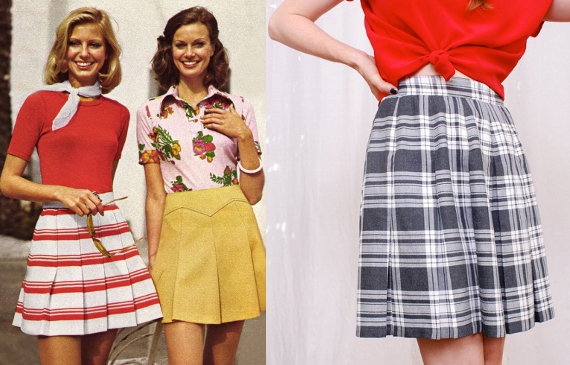
WHAT IT IS: Scooter skirts from the ‘70s look a whole lot like Catholic schoolgirl skirts look today, but with a huge difference: These “skirts” were actually shorts that are pleated to appear as skirts.
I remember scooter skirts making a revival in the early ‘90s of my youth and were called “skorts:” A mix of skirt + shorts = skorts.
THE HISTORY: While the mini skirt was all the rage in the ‘60s, the “skort” was a more popular way to expose the area above the knee by the youth of the early ‘70s. The mini skirt transitioned into the scooter skirt when hot pants (extremely short and skin tight shorts) emerged in the ‘70s.
So why was it called a scooter skirt? Only someone who lived the era would truly know, but my best guess is that when the razor scooter gained popularity girls began wearing their “pantskirts” on the scooters so that they wouldn’t expose their undergarments below. Hence, the nickname scooter skirt would emerge and gain hold of the American consciousness.
’70s plaid wasn’t the only print for these schoolgirl scooters. Solid hues and psychedelic stripes were also prevalent and worn from the knee up!
BUY THEM NOW: ’70s Schoolgirl Plaid Scooter Skirt
on Etsy, $78 / ’70s Tartan Plaid Scooter Skirt
on Etsy, $42
Click here to be taken back to the Table of Contents.
’70s CLOTHING TREND #3: FLARED JEANS

WHAT IT IS: Jeans found their way into the drawers of the American teen as early as the ‘50s, but it wasn’t until the ‘70s that woman were wearing pants, let alone pants made from such a casual material as denim.
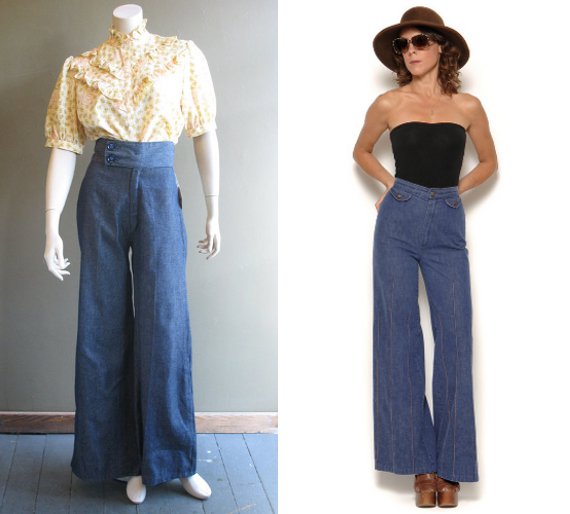
Wide-legged, flared, bell bottoms … whatever you want to call them, they were in for the contemporary female by the mid ‘70s and worn by celebrities like actress Jane Birkin, above.
THE HISTORY: Before the ‘50s, denim was still something to be worn by a miner, farmer or other blue collar, toiling worker. Beginning with the baby boomer generation, “jeans” transitioned into everyday casual wear by teen boys and girls.
While we most commonly associate the specific wide-legged jeans with the hippie generation of the 1970s, this denim style was more common than you think.
Denim-only brands were founded or grew from previous origins to gain market share over this growing trend, introducing cleaner, sleeker versions of the “hippie denim” associated with work wear grunge and a general alternative lifestyle.
Still, The average woman wasn’t wearing jeans like the average woman does today. Now, wearing jeans is as common as owning a pair of socks. In the ‘70s, on the other hand, our “elders” were still wearing conservative skirts and/or pant suits. It was the easily impressionable youth who sought after the denim craze as led by brands like Levis, Lee and Wrangler, all of which still exist today.

BUY THEM NOW: ’70s High-Waisted Flared Denim Jeans
on Etsy, $68 / ’70s High-Waisted Dark Denim Jeans
on Etsy, $72
Click here to be taken back to the Table of Contents.
’70s CLOTHING TREND #4: ASCOT BLOUSES
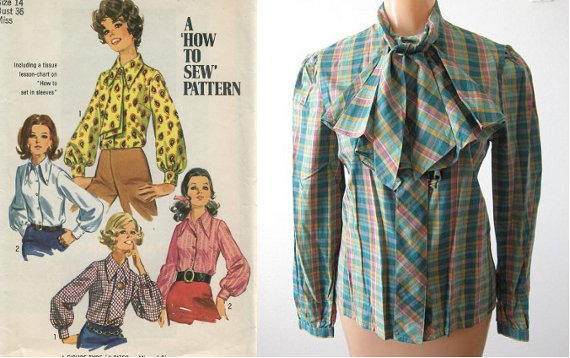
WHAT IT IS: The “ascot” is anything attached to the neck of a shirt. There are different kinds of ascots, from simple ascot ties (which can simply hang or be tied into decorative bows) to my favorite, the “crepe” ascot.
A crepe ascot (shown above) is type of ascot that lays like the ruffles of a jabot. It’s essentially taking the of the ascot but preventing its wearer from “tying” it in any sort of fashion. It just lies as is.
Ascot blouses have many a nickname, including “secretary” blouses,
“pussy cat” blousesand even “working girl” blouses because their increased popularity in the ‘70s can be attributed to women wearing them as they increasingly entered the office-focused workforce. American Bureau of Labor statistics show that in 1970, nearly 40% of the American female population were employed. By 1979, that number jumped to nearly 48% of women in the workforce. That’s a lot of secretary blouses going around!
Unfortunately the nickname secretary blouse is demeaning because it insinuates that if working, a woman was supposed to be a secretary. Think of Polly’s character in Mad Menand the terrible prejudice she had to experience to work her way to the top — “secretary” blouses and all.
THE HISTORY: But the interesting history of the ascot blouse doesn’t stop there. The ascot reached its height of popularity as a men’s style in the 1800s. Beautiful silk scarves were worn in multiple decorative fashions below a sports jacket in the area around the neck where a man’s shirt would normally show.
The ascot tie gained popularity in mainstream fashion once again by the ‘60s, but this time it was more popular for women to wear feminine, decorative scarves around their necks in various fashions. This trend then transitioned into the ascot tie “secretary blouse” because the ascot tie was almost like having the feminine version of the man’s tie in the work place.
So while women weren’t actually wearing men’s tie, the ascot tie blouse was almost a way for them to declare with their style that they were dressed to work.
BUY THEM NOW: ’70s Plaid Ascot Crepe Blouse
on Etsy, $20 / ’70s Red Ascot Crepe Blouse
on Etsy, $12
Click here to be taken back to the Table of Contents.
’70s CLOTHING TREND #5: FAUX ANIMAL PRINT FUR COATS
WHAT IT IS: The faux fur industry took off in the late ’60s and was worn in lieu of real fur as waist coats and dress coats. It came with appropriate timing, too, because the need to wear the warmth of real fur was increasingly becoming less with the advent of heated cars and public transportation. Women didn’t need to “bundle up” 24/7 — they could wear less when traveling to and from destinations thanks to modern technologies and accessibility to them by the average American.
’70s styles in faux fur coats were more designed as “jackets,” garments slightly past the waist clasped with zippers or buttons instead of more fancy enclosures seen in previous eras. The entire outerwear trend became more casual in the ’70s, which was a reflection of the more casual clothing women were wearing all around. Who would want to wear a fancy coat over denim and an ascot blouse?
THE HISTORY: The popularity of the “faux fur” industry has an interesting history, one of which stems from the near extinction of leopards as influenced by Jacklyn Kennedy’s wardrobe choices!
While fur was not a revolutionary trend for the ‘60s, wearing fur designed with animal prints was.
So when First Lady Jackie Kennedy was encouraged to wear a leopard animal fur coat by Oleg Cassini — one of her most prized couturiers during her time at the White House — she was excited to change up “the fur look” in a fresh way.
Well, who would have known that once Jackie O wore her real leopard coat as designed by Cassini, that the woman of America would demand their own versions — and that over 250,000 leopards were hunted and killed to meet the consumer’s fashion demands?
Because Jackie was an influential fashion force of her day, this is exactly what happened. Cassini has worked to redeem his influence on the near extinction of the leopard population by funding the development of synthetic fur called Evolutionary Fur, which essentially duplicate the spotted design of the leopard without harm to the animal.
So, because Jackie’s fashion sense created a fashion massacre, it became popular to channel the animal print trend through it’s faux fur counterparts.
Faux fur was technically invented in 1929, but thanks to Cassini’s efforts as well as increased technology of synthetic fibers in general, the industry was able to capitalize on a tragedy and turn it into a trend.
BUY THEM NOW: ’70s Faux Leopard Print Coat
on Etsy, $150 / ’70s Faux Fur Animal Print Coat
on Etsy, $38
Click here to be taken back to the Table of Contents.
’70s CLOTHING TREND #6: HOODED DRESSES
WHAT IT IS: A dress, most usually made from cotton or polyester, that has an attached hood.
It’s like Little Red Riding Hood hit the ’70s and made her successful red cape into a best-selling dress! There was no true purpose for the hood on the dress. It was merely an accent piece that added another layer of unique style to the dress garment, fitting for a period of self-expression and liberated fashion ideology.
THE HISTORY: The “hood” descends from Medievil times, when men and women wore hooded cloaks/capes to protect their hair and face from harsh weather conditions. The benefit of having a hood on your outergarment was that you didn’t have to worry about another piece to include in your outfit. People were moving about freely on horse and foot, therefore it was in their best interest to wear the garments that had everything they needed in one place.
Because the Medieval-style peasant dress trend was so huge in the ’70s, it makes sense that the hooded dress would gain popularity, too since it took the Medieval cape trend and designed it into this ’70s dress.
It can be worn both casually or flamboyantly — it all depends what you make of it. Legendary
’70s designer Halston dressed his friends/cliente like Bianca Jagger in his famous hooded disco dress. While not necessarily invented by Halston, the hooded dress is representative of his brand synergy of mixing the nightlife with everyday functional clothing, like the ultraseude dress he invented and which gained him mainstream notoriety.
BUY THEM NOW: ’70s Green Striped Hooded Dress
on Etsy, $48 / ’70s Teal Hooded Day Dress
on Etsy, $46
Click here to be taken back to the Table of Contents.
’70s CLOTHING TREND #7: CHEVRON STRIPES
WHAT IT IS: The chevron is a type of stripe that rather than move upward vertically or across horizontally, is a mix of both up & down as a diagonally cut array of upward pointing arrows. It’s best described as an “inverted V,” almost like the side of a square turned upside down into a rhombus, and then split in half.
Beyond fashion, the chevron is most commonly associated with being an insignia to denote the rank of people working in the military or police professions. The chevron stripe is used on the badge to illustrate their rank standing. One can also find various degrees of chevron stripes within the design of flags and also as the symbol of car company Chevron!
TREND HISTORY: The ’70s trend of the chevron stripe in both dresses and skirts can be attributed to the era’s popularity of the Missoni brand, which incorporated the zig-zag flare of the chevron stripe into its signature designs.
Founded in the ’50s by husband-wife duo Tai and Rosita Missoni, the brand was promoted by Vogue magazine editor Diana Vreeland and thereby catapulting this European brand to American prominence by the early ’70s.
When a designer’s signature look becomes trendy, knock-offs emerge at lower price points. Hence the mainstream trend of the chevron stripe, which was a key component of the multi-colored kaleidoscope zig zags of the Missoni “look.”
BUY THEM NOW: ’70s Chevron Stripe Maxi Skirt
on Etsy, $29 / ’70s Chevron Stripe Sundress
on Etsy, $39
Click here to be taken back to the Table of Contents.
’70s CLOTHING TREND #8: PRAIRIE DRESSES
WHAT IT IS: Prairie dresses are a mix of European Medieval peasant dresses and the American Little House on the Prairie country-girl style.
This ’70s dress style is best epitomized when designed with a high or square neckline with attached lace ruffles at the chest, ruffles at the sleeves and a layer of ruffle to finish off the dress skirt.
The dress is cut as a high-waist line and usually has a wrap tie. Prints range from calico to floral to a clean all-white look. Prairie dresses can be both maxi or knee-length, but hardly ever mini.
Prairie dresses were conservative, country-girl styles that spoke to the era’s influences of following the natural, organic lifestyles of a simpler time in world history.
THE HISTORY: Remember buying Jessica McClintock dresses for prom in the ’90s? Well, the owner of Jessica McClintock — Gunne Sax — is the most notable designer and trend-originator of the prairie dress style.
Gunne Sax was famous for the high necklines, tight bodices and flared ruffle skirts so indicative of the prairie dress look. For added feminine flair, Gunne added Victorian elements like lace, pearl buttons and slip dresses below the dress itself.
The prairie skirt worn by homespun fashionistas on the American range in the mid 1800s were simplified versions of the ruffled skirts/dresses characteristic of high fashion from that time period. Upon hearing the latest trends of the upper class, women would take those trends and make them into affordable and accessible looks for their lifestyles.
Other pioneers of the prairie look emergence in mainstream ’70s fashion was Ralph Lauren, who incorporated various elements of American Western wear into his collections during the late ’70s and early ’80s.
BUY THEM NOW: ’70s Floral Prairie Dress
on Etsy, $36 / ’70s Calico Floral Print Prairie Dress
on Etsy, $58
Click here to be taken back to the Table of Contents.
’70s CLOTHING TREND #9: FLOPPY HATS
WHAT IT IS: A “floppy” hat is a wide-brimmed hat with a circle, almost bucket-like top. The floppy hat is called floppy because it does just that: It’s not a static fit on your head and can be adjusted and moved accordingly. Floppy hats are also called sun hats or field hats because their wide-brims prevent the sun from hitting a person’s eyes and face.
In the ’70s, floppy hats were typically made from felt material and available in a variety of bright colors to match a woman’s outfit. They sometimes were decorated with flowers or other earth-inspired materials (see Bridgette Bardot, above) or accented with a simple ribbon bow.
THE HISTORY: Previous to the ’70s, women wore hats to match their outfits. A woman’s hat collection was by far the equivalency of a modern woman’s shoe collection today — you simply needed to have that one hat to match that one outfit!
By the ’70s, wearing a hat everywhere you went just wasn’t practical to the conveniences of the time. It was a style still embraced by the older populations, but baby boomers and those who followed adopted their own hat trends which were more suitable to stylish practically of blocking the sun and channeling the era’s organic, natural vibe.
Today hats are still embraced by a niche percent of the American female population. The floppy hat has made a comeback, sold new in trendy hipster stores like Urban Outfitters and American Apparel. The Marc Jacob’s runway for spring 2011 embraced the return of the floppy hat in exaggerated shape and blindly bright magenta hues.
BUY THEM NOW: ’70s Red Floppy Hat
on Etsy, $30 / ’70s Mustard Yellow Floppy Hat
on Etsy, $60
Click here to be taken back to the Table of Contents.
’70s CLOTHING TREND #10: PLATFORM SHOES
BUY THEM NOW: ’70s Size 6.5 Cork Platforms
on Etsy, $180 / ’70s Size 7 Wooden Platforms
on Etsy, $150 / (lower left) ’70s Size 7.5 Floral Strappy Platforms
on Etsy, $150
WHAT IT IS: Platform shoes are elevated footwear at fairly considerable heights. Heeled shoes may elevate your height, but they don’t give you the same boost that platforms do of 3-6+ inches.
In the ’70s platform shoes were usually made from cork or wood. The foot rests on top of the platform sole and is strapped in around the ankles and fastened with straps at the front of the foot, allowing the toe to peep through.
THE HISTORY: Most people assume that the platform is a product of the ’70s — wrong! Shoes of elevated heights span as far back to the day of the Egyptian, when wealthy Pharaohs and their royal followers would wear platforms as a sign of wealth & prestige.
Women and men wore platforms called “chopins” of exorbitant heights (up to 16 inches in some cases!) during the Renaissance, when trade of these shoes were at an all-time high and individuals of growing wealth & stature wanted to show off their economical position with a little bit of height.
Around the time of the French Revolution during the late 1700s, the allure of the platform dwindled down because the shoe was associated with the negative opulence of Louis XVI and his court.
Fast forward 200 years and we can thank legendary Italian shoe designer
Salvatore Ferragamo for giving the platform shoe trend a boost in 20th century fashions. While Ferragamo is more remembered for the invention of the stiletto (God bless him!) it was his European background coupled with desires for experimentation with creating footwear that had never been seen in the American market before that helped to re-introduce the platform shoe back into the American market.
When the glam rock scene of London hit the dance floors of the US, all platforms were let loose and everyone was wearing them from stage performers like David Bowie to 14-year-old girls following the cutting edge trends of their time.
Today, designers like Jeffrey Campbell take inspiration from Ferragamo’s ’70s platform designs. When each side is shown side by side, it can be hard to tell which is truly “vintage!”